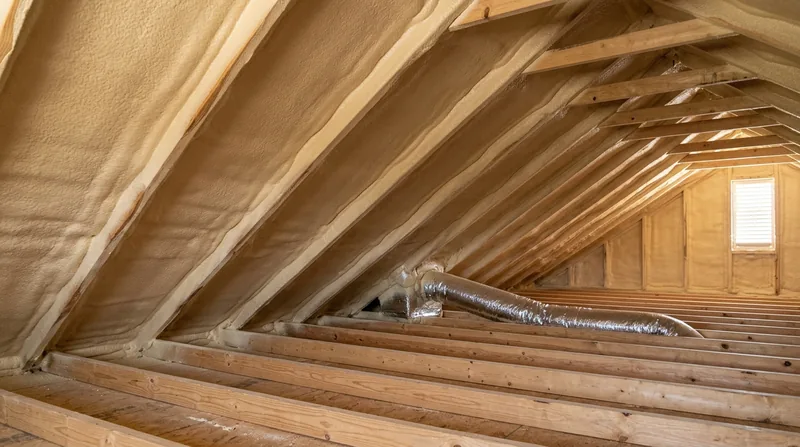




Sioux City attics swing between hot, humid summers and cold, windy winters along the Missouri River corridor. Homes perched in the Loess Hills above downtown, mid-century ranches across Morningside and Leeds, and newer subdivisions pushing toward Sergeant Bluff all face the same challenge: an attic that bleeds heat in winter and absorbs it in summer, driving heating and cooling costs year-round. Older homes carry flattened, degraded insulation that cannot seal against seasonal moisture swings, while even newer builds toward Sergeant Bluff often run vented attics over bonus rooms and garage spaces. Attic spray foam insulation in Sioux City seals the roof deck against that swing, eliminating drafts, stopping heat gain, and cutting the load on your HVAC system. We spray closed cell foam across the attic in older Morningside homes and newer builds alike, creating a continuous thermal and air barrier that works all year. The result is a stable attic, lower utility bills, and a home that stays comfortable without fighting the continental climate. Call us at (712) 522-2693 for a free estimate, or visit our homepage to learn how spray foam insulation works across greater Sioux City.
Why Attic Insulation Fails in Sioux City and How Spray Foam Fixes It
Sioux City's continental climate and variable terrain create specific attic failure modes that fiberglass and blown-in insulation cannot solve. The cold, windy winters push moisture outward through rim joists and top plates, while hot, humid summers reverse that vapor drive and push moisture inward through the same gaps. Older attics with settled, compressed insulation lose R-value and allow air to circulate freely, wasting energy and allowing condensation to form on roof decks in spring. Vented attics in newer subdivisions near Sergeant Bluff pull hot, humid air into the attic during summer, overwhelming any insulation beneath the bonus room or garage ceiling. Spray foam seals the attic against air infiltration and controls vapor on both sides of the seasonal swing, stopping the leak before it starts.
- We remove flattened, degraded insulation from older Morningside and Leeds homes before spraying closed cell foam across the roof deck.
- We seal the attic against the seasonal moisture swing that causes condensation and mold risk on roof decks and rafters.
- We eliminate air leaks at top plates, penetrations, and ductwork chases that allow heated or cooled air to escape into the unconditioned attic.
- We create a sealed attic that reduces the load on your heating and cooling system, lowering utility costs through the year.
The result is an attic that stays dry, stable, and energy-efficient, no matter how cold the winter or how humid the summer along the Missouri River.
Key info: Sioux City's Loess Hills terrain and hillside homes in Morningside face higher heating bills because cold air sinks into basements and rim joists while hot attics in summer pull conditioning load upward. Sealed attics with closed cell foam reverse that stack effect, keeping conditioned air where you need it.
For more on how air sealing complements spray foam insulation, see our air sealing page.
How We Spray Attic Foam in Sioux City: Step-by-Step Process
Attic spray foam insulation begins with a full site walkthrough to measure the attic, identify air leaks, check for moisture or contamination, and plan the spray pattern. We assess whether the attic deck is sound and dry before we begin, because we do not spray over wet, leaking, or contaminated substrates. We provide a written estimate that specifies the R-value and foam thickness you will receive, so you know exactly what you are paying for. On the spray day, we set up mechanical ventilation to manage cure fumes, control the spray temperature and drum ratio to manufacturer specs, and apply the foam in passes that build to the target thickness without over-application. We document the work with photographs and a completion report, then advise you on the re-entry window (typically 24 to 48 hours) before you use the attic space or turn on the HVAC system.
- We inspect the attic for moisture, roof leaks, and contamination, and walk away if the substrate is not dry and sound.
- We measure the attic square footage and calculate the board feet of foam needed to meet your R-value target.
- We set up mechanical ventilation and control spray temperature, drum pressure, and mix ratio to manufacturer specifications.
- We apply closed cell foam in multiple passes, building to the specified thickness without over-spray or waste.
- We seal all air leaks at the rim joist line, top plates, penetrations, and ductwork chases before we finish the roof deck.
- We provide a written completion report and advise you on the re-entry window before you occupy the space or restart HVAC equipment.
This process takes one to three days depending on attic size and complexity, and we schedule work around your schedule and the Sioux City building season.
Example: A 1,500-square-foot attic in a Morningside home with vented soffit penetrations and a knob-and-tube wiring run requires mechanical ventilation during cure and a 48-hour re-entry window. We seal the soffit penetrations before spraying the roof deck, then provide a completion report with R-value and thickness specs. The homeowner stays out of the attic for two days, then the space is ready for storage or HVAC equipment.
Learn more about our closed cell spray foam insulation and why it is the right choice for sealed attics.
Attic Spray Foam Insulation Methods: Closed Cell vs. Open Cell
| Approach | Description | Best for |
|---|---|---|
| Closed Cell Spray Foam | High-density foam (1.5 to 2.0 lb/cu ft) that cures rigid and air-tight. R-value approximately 6.0 to 6.5 per inch. Impermeable to moisture vapor. Requires mechanical ventilation during cure. | Sealed attics in Sioux City's continental climate, where vapor drive reverses seasonally. Controls moisture on both sides of the envelope. Best for homes in Morningside, Leeds, and newer subdivisions toward Sergeant Bluff. |
| Open Cell Spray Foam | Low-density foam (0.5 to 0.7 lb/cu ft) that cures soft and semi-flexible. R-value approximately 3.5 per inch. Vapor-permeable. Lower material cost. Faster cure time. | Attics where sound dampening is a priority, or where budget is the primary driver. Not recommended for Sioux City sealed attics because it does not control seasonal vapor drive. Better for garages or non-conditioned spaces. |
| Blown-In Insulation (Cellulose or Fiberglass) | Loose-fill material blown to depth. R-value 3.2 to 3.6 per inch. Does not seal air leaks. Settles over time, losing R-value. Allows air circulation through the attic. | Top-up of an existing sound attic with no air leak issues. Lower cost per board foot. Not a replacement for failed insulation or air sealing. Does not address Sioux City's seasonal moisture swing. |
| Insulation Removal and Replacement | Complete tear-out of failed, settled, or contaminated insulation before new foam or blown-in material is installed. Clears the attic deck for a clean application. Includes haul-away and disposal. | Older Morningside and Leeds homes with compressed, degraded fiberglass or cellulose. Mandatory before spray foam in any retrofit. Allows inspection of the roof deck and framing for leaks or rot. |
For most Sioux City homeowners, closed cell spray foam is the right choice because it seals the attic and controls the seasonal moisture swing that dominates this region. Open cell foam is a lower-cost option if budget is tight, but it does not address the vapor drive issue. Blown-in insulation is sometimes the right answer if your attic insulation is sound and you simply need more R-value, but we will tell you so honestly rather than sell you a more expensive solution.
Attic Spray Foam Insulation Cost in Sioux City: What to Expect
Attic spray foam insulation in Sioux City typically starts at $1.50 per square foot for closed cell foam and climbs based on attic size, accessibility, and the amount of insulation removal required beforehand. A 1,000-square-foot attic with no existing insulation and clear access might run $1,500 to $2,000 for closed cell foam at R-38 to R-50. An older Morningside home with settled fiberglass and rim joist penetrations will cost more because we must remove the old insulation first, then seal air leaks before spraying. Attics with limited roof access, knob-and-tube wiring, or asbestos-flagged vermiculite require extra care and time, raising the cost per square foot. The best way to understand your price is to get a written estimate that specifies the R-value, foam thickness, and what is included in the scope. We provide free estimates within 24 hours at (712) 522-2693, with no obligation to book. Visit our pricing page for more detail on what drives cost up or down.
Factors that affect the final price include attic square footage, existing insulation removal, air leak sealing at rim joists and top plates, and whether the attic deck needs repair or treatment before foam is applied. A top-up of a sound attic with blown-in insulation is cheaper than a full retrofit with foam, but it does not address air leaks or seasonal moisture issues. Permits and inspections vary by city within Sioux City and surrounding areas, so we help you understand what applies at your address. Always get 2 to 3 estimates before you commit, and compare the R-value and thickness specs, not just the price per square foot.
Attic Spray Foam Insulation Near Me: What Sioux City Homeowners Should Know Before Hiring
Hiring a spray foam contractor is a major decision, and the market includes both local, independent shops and national franchises, as well as rig-and-run crews from out of state that spray a job in an afternoon and disappear when the smell lingers or the foam shrinks. The difference between a good installation and a bad one is not always visible in the first week, but it shows up in the re-entry window, the smell, the thermal performance, and the durability of the seal. Here is what to look for when you call a contractor near Sioux City.
- Verify that the contractor is fully insured and ask for a certificate of insurance naming your address as an additional insured.
- Request a written estimate that specifies the R-value, foam thickness in inches, and the total board feet of foam to be applied.
- Ask whether the contractor will set up mechanical ventilation during cure and what re-entry window they will advise after the job is complete.
- Check references from recent attic jobs in Sioux City, Sergeant Bluff, or nearby towns, and ask about the smell and cure time they experienced.
- Confirm that the contractor will inspect the attic for moisture, roof leaks, and contamination before beginning, and ask what happens if the deck is not dry.
- Ask about the warranty on the installation work and whether the foam is backed by a manufacturer system warranty.
- Understand what permits apply at your address by checking with your local building department, and confirm that the contractor will help you navigate the process.
A reputable contractor will answer these questions clearly and provide references you can call. Avoid any estimate with no R-value and thickness specified, any promise of immediate re-entry, or any price far below market. Call us at (712) 522-2693 or visit our contact page to get a free estimate and see how we work. For more guidance on hiring any contractor, consult the Better Business Bureau Sioux City chapter, which maintains records of complaints and resolutions for contractors in the area.
Attic Spray Foam Insulation in Sioux City: Pricing Guide
| Service | Price | Details |
|---|---|---|
| Closed Cell Spray Foam Attic | Starting at $1.50/sq ft | High-density foam sealing the roof deck. Cost climbs with attic size, insulation removal, and air leak sealing at rim joists |
| Open Cell Spray Foam Attic | Starting at $0.85/sq ft | Lower-density foam for budget-conscious projects. Does not control seasonal moisture swing in Sioux City climate |
| Insulation Removal and Replacement | On estimate | Tear-out of failed fiberglass or cellulose from older Morningside and Leeds homes before new foam is applied |
| Air Sealing with Foam Application | Included | Sealing rim joists, top plates, penetrations, and ductwork chases as part of the attic foam spray scope |
| Travel | Included | No mileage fee or travel charge for jobs within Sioux City and surrounding service areas |
| Free Estimate | Free | Written quote with R-value and thickness specs, response within 24 hours at (712) 522-2693, no obligation to book |
Indicative pricing, the exact cost depends on square footage, finish, and site access. Free personalized estimate within 24h at (712) 522-2693.


