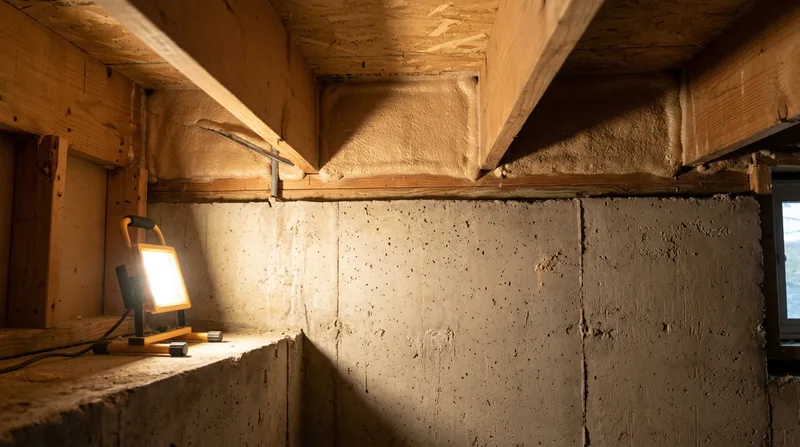




Closed cell spray foam insulation in Sioux City tackles the moisture and cold that plague homes perched in the Loess Hills and those with full basements across Woodbury County. The continental climate here swings hard between seasons: frozen winters push heat loss outward through rim joists and band joists, while hot, humid summers drive moisture inward through those same penetrations and basement walls. Older homes in Morningside, Leeds, and the hillside neighborhoods above downtown carry rim joists that bleed cold all winter, and many sit on damp foundations that stay cold and wet long after spring rains. Closed cell foam stops both problems at once. It blocks moisture, adds structural rigidity to hillside foundations, and holds an R-value of 6 to 7 per inch, so a modest thickness delivers the thermal break these homes need. We have been serving Sioux City, Sergeant Bluff, and surrounding Woodbury County since 2015, and we know the specific failure modes that hit this region hard.
Why Closed Cell Spray Foam Matters in Sioux City: Moisture Control on Hillside Lots
The Loess Hills and the Missouri River valley create a unique moisture challenge across Greater Sioux City. Homes built on hillside lots in the Loess Hills above downtown and in neighborhoods like Morningside face water intrusion at the rim joist and band joist where the foundation meets the wood frame. After spring rains and during humid summers, that moisture wicks into the rim cavity and into basement walls. Traditional fiberglass batts and blown cellulose absorb that moisture, compress, and lose their R-value. Closed cell foam, by contrast, sheds water and maintains its thermal resistance even when damp. It also adds rigidity to a rim joist, which matters on steep hillside lots where foundation settling can open gaps.
- We seal rim joists and band joists with closed cell foam to block moisture and prevent heat loss in homes across Woodbury County and into Plymouth and Sioux counties.
- We apply closed cell to basement walls and crawl spaces where moisture is chronic, protecting the foundation and the wood frame above it.
- Closed cell foam resists moisture better than open cell or blown-in insulation, so it outperforms in damp basements and on hillside lots where water intrusion is predictable.
- We pair closed cell foam with air sealing at rim joists, top plates, and penetrations to stop the seasonal vapor drive that reverses between winter and summer.
Stopping moisture at the rim joist and basement wall is the single biggest reason homeowners in Sioux City choose closed cell spray foam.
Key info: A home on a hillside lot in Morningside or Leeds with a damp basement and a cold rim joist will see the biggest payoff from closed cell foam. The foam blocks moisture, holds its R-value, and eliminates the seasonal odor and mold risk that comes with wet fiberglass.
For more on how air sealing complements foam insulation, see our air sealing service page.
How We Install Closed Cell Spray Foam Insulation in Sioux City
Closed cell spray foam is sprayed on site and expands to fill cavities, cracks, and voids. The process is fast and precise, but it requires controlled conditions and proper technique. We spray closed cell foam at the correct drum temperature and chemical ratio, apply it in multiple thin passes to avoid trapping solvents, and ensure mechanical ventilation during the cure period. The foam hardens in minutes and reaches full cure in 24 to 48 hours. We give you a re-entry window so you know when it is safe to occupy the space again. We measure thickness and R-value on site and document both on your estimate so you know exactly what you are paying for.
- We inspect the substrate (rim joist, basement wall, crawl space rim, or metal building wall) and address any active moisture or contamination before we spray.
- We set up mechanical ventilation in the work area during application and cure to manage off-gassing and ensure worker safety.
- We spray closed cell foam in controlled passes, building thickness gradually to avoid trapping volatiles and ensuring uniform density.
- We measure the final thickness and R-value on site, document it in writing, and explain the thermal performance you have gained.
- We provide a written re-entry window (typically 24 to 48 hours) so you know when the space is safe to occupy again.
Correct installation is the difference between a job that works and a job that smells bad for months. We do it right.
Real example: A home in Sioux City with a damp basement wall and a cold rim joist typically gets 2 to 3 inches of closed cell foam on the rim joist and 1.5 to 2.5 inches on the basement wall. We spray it in two or three passes, ventilate for the full cure period, and document R-values of R-12 to R-21 on the rim joist and R-9 to R-18 on the basement wall depending on thickness. The homeowner gets a 24-hour re-entry window and a written estimate showing exactly what they paid for.
For details on how we handle insulation removal before we spray, see our insulation removal service.
Closed Cell Spray Foam Installation Methods and Applications
| Application | Description | Best for |
|---|---|---|
| Rim Joist and Band Joist | Spray 2 to 3 inches of closed cell foam directly onto the rim cavity and the header band. The foam blocks air leakage, moisture, and thermal bridging in one step. No batt installation or blocking required. | Homes across Sioux City, Sergeant Bluff, and hillside lots in Morningside and Leeds where rim joists are cold and damp. |
| Basement and Crawl Space Walls | Spray 1.5 to 2.5 inches of closed cell foam on interior basement walls or crawl space rim. The foam resists moisture, maintains R-value even when damp, and creates a vapor barrier that stops seasonal moisture drive. | Basements and crawl spaces in Woodbury County where moisture is chronic or seasonal and the rim joist or band joist needs thermal protection. |
| Metal Building and Pole Barn Walls | Spray closed cell foam on the interior face of metal panels or directly on steel framing. The foam controls condensation on the steel, adds insulation, and provides a thermal break that stops sweat and dripping in summer and cold in winter. | Farm buildings, barndominiums, and metal-frame structures across Siouxland where condensation control is critical and the building has no internal temperature regulation. |
| Sealed Attic Decks and Rafter Cavities | Spray closed cell foam on the underside of roof decking or in rafter bays to create a sealed, conditioned attic. The foam is an air barrier, a vapor barrier, and insulation in one application. No soffit vents are needed. | Newer subdivisions near Sergeant Bluff and homes with bonus rooms, vented attics over living space, or HVAC equipment in the attic that needs protection from outside air. |
| Wall Cavity Retrofit (Injection Foam) | Drill access holes in exterior walls and inject closed cell foam into the cavities of pre-1980 homes. The foam fills cavities completely, blocks air leakage, and adds structural bracing. No demolition is required. | Older homes in Sioux City with empty wall cavities, wood-frame construction, and no interior insulation. Common in mid-century ranches and homes in the Loess Hills neighborhoods. |
Closed Cell Spray Foam Insulation Cost in Sioux City: What to Expect
Closed cell spray foam insulation in Sioux City typically starts at $1.20 per board foot and can range higher depending on the size of the job, the location, and the substrate condition. A rim joist on a typical home in Sioux City might need 40 to 80 board feet of foam, bringing the cost to $48 to $96 for that rim alone. A full basement wall retrofit or a sealed attic deck can run into hundreds or thousands of board feet. The total cost depends on how much foam is needed, how accessible the work is, and whether we need to remove old insulation first.
Several factors move the price up or down. Thick applications (3 inches or more) cost more per board foot than thin ones because we have to make more passes. Difficult access, such as a cramped basement or a narrow crawl space, can slow the work and increase labor. Substrate issues like active moisture, mold, or contamination mean we stop, address the root cause, and may refer you to another trade. A home that needs insulation removal before we spray will incur removal costs in addition to the foam cost. Getting multiple estimates from different contractors is the only way to understand the true cost for your specific home.
Cost example: A Sioux City home with a 40-foot rim joist cavity that needs 2.5 inches of closed cell foam might require 50 to 70 board feet. At $1.20 per board foot, that is $60 to $84 for material and labor. If the basement wall also needs 1.5 inches over 400 square feet, add another 60 board feet and $72 for that work. The total might be $130 to $160 for both the rim joist and basement wall, depending on access and substrate condition.
For a detailed breakdown of pricing across all our services, see our full pricing page.
What to Look for When Hiring a Closed Cell Spray Foam Insulation Contractor Near Me in Sioux City
Hiring the right spray foam contractor is critical because the installation quality determines whether the foam performs and whether you have problems down the road. The spray foam market includes national franchises, out-of-state rigs that come in for a single job, and local independent shops. A local contractor with a Sioux City address, local plates, and a reputation built over years is your best bet. When you are comparing contractors, ask for written estimates that include the R-value and thickness of the foam, the number of passes, and the re-entry window. Any estimate without those details is incomplete. Ask about mechanical ventilation during cure. Cheap quotes that promise immediate re-entry or foam that is ready to use in hours should raise a flag. Verify that the contractor is fully insured and ask to see the certificate. Ask for references from recent jobs in Sioux City, Sergeant Bluff, or nearby areas, and call them.
- Request a written estimate that shows R-value, thickness, number of passes, and the re-entry window so you know exactly what you are paying for and when the space is safe.
- Ask whether the contractor uses mechanical ventilation during application and cure, and for how long, because that is the mark of a professional installation.
- Verify that the contractor is fully insured and ask to see proof of coverage before work begins.
- Call references from recent jobs in Sioux City or nearby towns and ask about the smell during cure, whether the contractor was reachable if problems came up, and whether the job stayed on schedule.
- Check whether any of the work requires a permit at your address by contacting your local building department, and confirm that the contractor understands what applies in your city.
- Ask whether the contractor removes old insulation before spraying, because that is a separate cost and a critical step if the old material is failed, wet, or contaminated.
Taking time to vet the contractor up front saves money and headaches later.
For a free estimate with no obligation, contact us today or call (712) 522-2693. We will assess your home, explain what closed cell foam can do, and give you a detailed written estimate with R-value and thickness specs.
Closed Cell Spray Foam Insulation in Sioux City: Pricing Guide
| Service | Price | Details |
|---|---|---|
| Rim Joist and Band Joist Foam | Starting at $1.20/board ft | Typical rim joist cavity needs 40 to 80 board feet depending on cavity depth and linear footage of the rim |
| Basement and Crawl Space Walls | Starting at $1.20/board ft | Thickness and coverage depend on wall area, moisture condition, and whether access is easy or requires scaffolding |
| Sealed Attic Deck and Rafter Cavity | Starting at $1.20/board ft | Large attic areas and rafter cavities can run 300 to 800 board feet; sealed attics are typically more expensive than rim joists |
| Metal Building and Pole Barn Insulation | Starting at $1.20/board ft | Square footage of wall or ceiling area determines board footage; condensation control on steel is the primary driver |
| Insulation Removal Before Foam | On estimate | Removal cost depends on material type, volume, and whether it is contaminated, wet, or contains asbestos-suspect materials |
| Estimate and Travel | Free | Response within 24 hours at (712) 522-2693 for Sioux City, Sergeant Bluff, and surrounding Woodbury County service areas |
Indicative pricing, the exact cost depends on square footage, finish, and site access. Free personalized estimate within 24h at (712) 522-2693.


