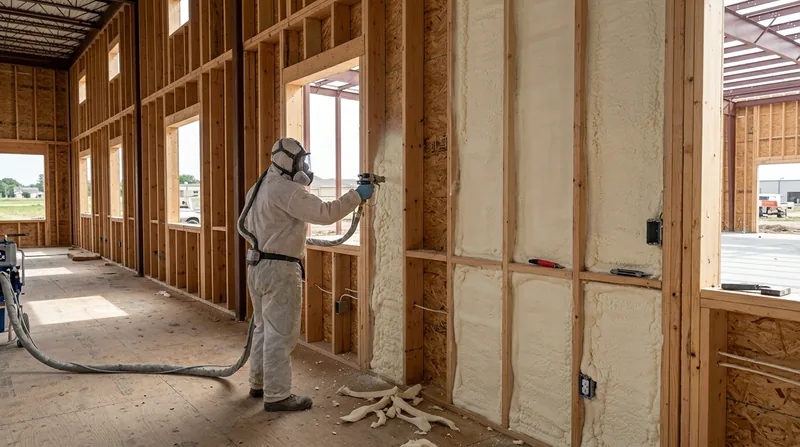




Commercial and new construction spray foam insulation in Sioux City protects buildings against the same relentless seasonal swings that drive heating and cooling bills across Woodbury and Plymouth counties. Siouxland's cold, windy winters and hot, humid summers create vapor drive that reverses twice a year, pushing moisture inward through the roof deck in summer and outward through rim joists and top plates in winter. New commercial shells and retrofit projects across the region face the same problem: an uncontrolled attic or crawl space bleeds energy in both directions, and the Missouri River corridor's weather extremes make that leak expensive. We work with contractors and property managers to size foam systems that seal and insulate commercial buildings on new builds and retrofits, managing both the thermal and moisture performance that Siouxland's climate demands. Our approach starts with an on-site assessment, written specifications with R-value and thickness, and controlled installation that meets code and manufacturer requirements.
Why Commercial and New Construction Spray Foam Matters in Siouxland
Commercial projects in Sioux City, Sergeant Bluff, Le Mars, and across the region operate in a climate where energy waste is measurable and expensive. A vented attic over a warehouse or a retail building in the Loess Hills loses heat all winter and absorbs solar gain all summer; a metal building without closed-cell foam on the roof deck sweats condensation that ruins inventory and corrodes steel. Unlike residential work, commercial buildings run year-round, often with controlled interior environments that amplify the cost of poor building envelope performance. Proper spray foam insulation and air sealing reduces that load, protects the structure, and improves the bottom line.
- We seal roof decks and attic cavities with closed-cell or open-cell foam to control both heat loss and moisture movement across the changing seasons.
- We air-seal rim joists, band joists, and wall cavities in new construction and retrofit projects to eliminate the drafts and thermal bridging that fiberglass alone cannot address.
- We remove failed or inadequate existing insulation and replace it with a foam system sized to the building, its use, and the code that governs it.
- We work with your general contractor to schedule installation, coordinate with other trades, and deliver specifications that satisfy the building department and the insurance carrier.
Commercial buildings in Siouxland operate in a climate that punishes poor envelope performance, and the right foam system pays for itself in reduced operating costs and extended building life.
Key info: Iowa's energy code requires air sealing and insulation specifications to be documented before work begins. We provide written estimates that include R-value, thickness, and the installation method so the building official and your contractor can verify compliance. Contact the Iowa Department of Energy for the current energy code and the building official in your city for what applies to your project.
How We Install Commercial and New Construction Spray Foam in Sioux City
Our installation process is built around controlled application, proper ventilation during cure, and documented specifications that satisfy code and your contractor. Every commercial job starts with a site visit to assess the substrate, roof pitch, cavity depth, and any existing insulation. We measure the space, calculate the board feet required, and prepare a written estimate with R-value and thickness so you know exactly what you are getting. On installation day, we set up mechanical ventilation to exhaust fumes during cure, apply foam in controlled passes to achieve the specified thickness without over-application, and document the work with photos and a completion sheet.
- We inspect the substrate for moisture, active leaks, or contamination and walk away if the surface is not dry and sound.
- We calculate board feet and select the foam type (closed-cell for vapor control on metal buildings and sealed attics, open-cell for sound dampening and cost savings on new construction walls).
- We set up mechanical ventilation to manage fumes and odor during the cure period, typically twenty-four to forty-eight hours before re-entry.
- We apply foam in uniform passes, maintaining the manufacturer's specified ratio and drum temperature, and verify thickness with a depth gauge as we go.
- We install thermal barriers or ignition barriers as required by the building code and the building official at your location.
- We provide a completion report with photos, board footage, R-value, and installation date so you have a record for the building official and your insurance carrier.
This methodical approach ensures the foam bonds properly, cures correctly, and meets code without the smell or re-entry delays that rush jobs create.
Example: A new metal building shell in Orange City requires closed-cell foam on the roof deck to prevent condensation on the steel and maintain a dry interior during seasonal humidity swings. We spray two inches of closed-cell at the manufacturer's specified ratio, install an ignition barrier per code, and provide the building owner with a completion sheet showing R-value and board footage. The result is a sealed, insulated structure that protects inventory and equipment all year.
See also: Metal Building and Barndominium Spray Foam for specialized applications in agricultural and rural commercial settings.
Commercial and New Construction Spray Foam Methods and Approaches
| Approach | Description | Best for |
|---|---|---|
| Closed-Cell Spray Foam | High-density foam at 3.5 to 3.8 pounds per cubic foot, R-value 6.0 to 6.5 per inch, vapor barrier function, structural adhesion. | Metal building roof decks, sealed attics, rim joists, and any cavity where moisture control and air sealing are critical. |
| Open-Cell Spray Foam | Lower-density foam at 0.5 to 1.5 pounds per cubic foot, R-value 3.5 to 3.8 per inch, vapor-permeable, sound dampening, cost-effective. | New construction walls, interior partitions, and attics where vapor drive is managed by venting or mechanical conditioning. |
| Injection Foam Retrofit | Closed-cell foam injected into existing wall cavities through small holes, no demolition, minimal disruption to finished surfaces. | Retrofit of pre-1980 commercial buildings with hollow walls, retrofit of masonry cavities, and retrofit without interior or exterior demolition. |
| Insulation Removal and Replacement | Complete removal of failed, compressed, or contaminated existing insulation, substrate preparation, and installation of new foam system. | Commercial buildings with settled or moisture-damaged attic insulation, and any retrofit where the existing layer cannot support the new system. |
Each approach is sized to the building, its use, and the code in force at your address. We help you choose the right method based on the substrate, the cavity, the climate, and your budget.
Commercial and New Construction Spray Foam Cost in Sioux City: What to Expect
Commercial spray foam pricing depends on the scope, the foam type, the square footage, and the building's condition. A free commercial estimate is the starting point: we visit the site, measure the area, assess the substrate, and provide a written quote with R-value, thickness, and total board footage. New construction jobs tend to be more predictable because the substrate is clean and the cavity is defined; retrofits cost more because we may need to remove existing insulation, repair the substrate, or work around existing mechanical systems. Access matters too: a ground-level warehouse is faster and cheaper than a three-story retail building where we need lifts or scaffolding.
Factors that affect your estimate include the foam type (closed-cell costs more per board foot but delivers higher R-value and vapor control; open-cell is cheaper and works well for new construction walls), the thickness required by code and your building's thermal goal, whether we are removing existing insulation, and the complexity of the cavity or roof deck. A straightforward sealed attic retrofit in Sioux City may run into the mid-range; a metal building retrofit with closed-cell and thermal barriers will be higher; a simple new construction wall spray on a shell may be lower. The best way to know is to get two or three estimates from contractors who provide written specifications, not just a per-board-foot quote.
We provide estimates at no cost and with no obligation. Call (712) 522-2693 to schedule an on-site visit, or use our contact form to request a free estimate and we will respond within 24 hours. See our pricing page for typical ranges and what is included at each level.
What to Look for When Hiring a Spray Foam Insulation Contractor Near Sioux City
Hiring the right contractor protects your building and your budget. The spray foam trade includes both local, independent shops and national franchises, and also rig-and-run crews that spray a job in an afternoon and disappear when the smell will not go away. The honest differentiator is straightforward: get a written estimate that includes R-value and thickness, ask about the installation method and ventilation during cure, check references and verify insurance, and understand what happens if something goes wrong after the job is done.
- Request a written estimate that specifies R-value, foam thickness in inches, total board footage, and the foam type (closed-cell or open-cell), so you can verify the specification meets code.
- Ask about mechanical ventilation during cure and the re-entry window, typically twenty-four to forty-eight hours, and be suspicious of any contractor who promises immediate re-entry.
- Verify insurance coverage by asking for a certificate of insurance naming your company as additional insured, and confirm the policy is active before work begins.
- Check references from recent commercial projects in your area, and ask those references about the quality of the installation, the contractor's responsiveness, and whether the job was completed on time.
- Understand the permitting process for your city: some jurisdictions require a permit for insulation work, others do not, and the building official at your address is the only authority that matters.
- Get two or three estimates so you can compare specifications and price, and be wary of any bid that is far below the others or that lacks detail on thickness and R-value.
A local contractor with a local address and verifiable insurance is your best protection. Contact us at our contact page to request a free estimate and to speak directly with someone who knows Siouxland's climate and building stock.
Commercial & New Construction Spray Foam in Sioux City: Pricing Guide
| Service | Price | Details |
|---|---|---|
| Free Commercial Estimate | Free | On-site assessment, written specification with R-value and thickness, no obligation to book, response within 24 hours |
| Closed-Cell Spray Foam | Starting at $1.50 to $2.50 per board foot | High-density foam with vapor barrier function, typical for sealed attics and metal building roof decks in Siouxland |
| Open-Cell Spray Foam | Starting at $0.80 to $1.40 per board foot | Lower-cost option for new construction walls and interior partitions where vapor management is handled by mechanical conditioning |
| Insulation Removal and Replacement | On estimate | Cost depends on volume of existing insulation, substrate condition, and disposal; typically added to new foam installation cost |
| Travel and Setup | Included | No separate mileage fee or travel charge within Sioux City and surrounding service areas across Woodbury and Plymouth counties |
Indicative pricing, the exact cost depends on square footage, finish, and site access. Free personalized estimate within 24h at (712) 522-2693.


