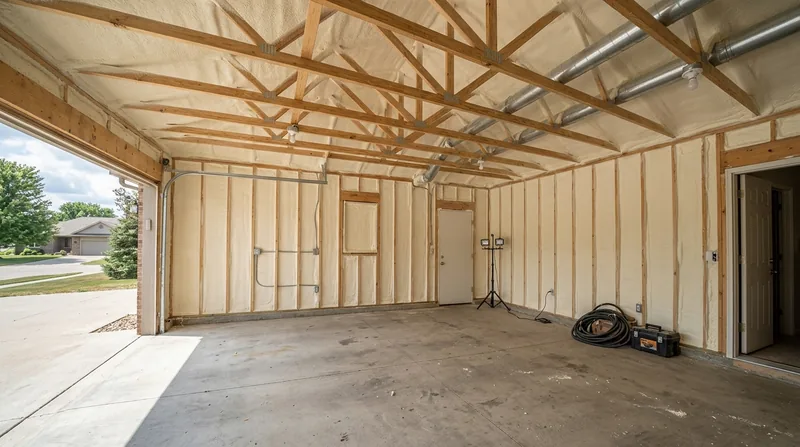




Garages across Sioux City face a unique challenge: they swing from scorching, humid summers to brutal, windy winters without the climate control of your home. A detached garage in the Loess Hills above downtown, a newer attached unit in Sergeant Bluff, a workspace in Hinton or Orange City, all of them leak heat and moisture into the walls and ceiling year round. Garage spray foam insulation seals that thermal envelope, turning an unusable space into one you can actually work in, park in, or finish as a bonus room without the seasonal temperature swings and humidity that plague uninsulated garages across the region. We foam garage walls, ceilings, and the rim joists that sit above foundation walls, stopping the cold and heat loss that drives up your whole-home energy bills and makes those spaces miserable.
Why Garage Insulation Matters in Sioux City's Climate
Sioux City's continental climate, cold, windy winters and hot, humid summers along the Missouri River corridor, creates two separate failure modes in uninsulated garages. In winter, the uninsulated ceiling and exterior walls bleed heat into a vented attic or to the outside, and the rim joist at the foundation band loses warmth to the basement below. In summer, humid air enters through those same gaps and condenses on cooler surfaces inside the garage, promoting mold growth and rust on tools, vehicles, and stored items. Newer subdivisions pushing toward Sergeant Bluff still frame bonus rooms above garages with standard vented attics, leaving those rooms swinging 40 to 50 degrees between seasons. Older detached garages in Leeds, Morningside, and across the hillside neighborhoods never had any insulation at all.
- Uninsulated garage ceilings allow hot attic air to radiate downward in summer and cold exterior air to sink through in winter, making the garage unusable for half the year.
- Rim joists and band joists around the foundation perimeter are the primary thermal bridge between the conditioned basement and the uninsulated garage, especially on hillside lots where the foundation sits partially above grade.
- Vapor drive reverses with the seasons, pushing moisture inward through walls in summer and outward through rim and band joists in winter, causing condensation, rust, and structural decay if left unchecked.
- Rooms above garages in newer subdivisions inherit the problem: a vented attic above an uninsulated garage ceiling means those bonus rooms stay cold in winter and hot in summer, forcing homeowners to run HVAC equipment inefficiently.
Closed cell foam stops all three failure modes at once: it seals air leaks, controls vapor drive in both directions, and insulates to R-6 per inch, giving you a usable garage year round.
Key info: In Sioux City and surrounding areas, the average homeowner with an uninsulated garage or bonus room above a garage loses 15 to 25 percent of their whole-home heating energy through the rim joist and uninsulated ceiling above the garage. A detached garage in the Loess Hills loses even more because it sits exposed on three sides.
For permit and code guidance specific to your address, contact the City of Sioux City Building Department or your local city or county building official. Attic ventilation requirements and thermal barrier rules vary by jurisdiction, and your building official will confirm what applies to your garage or bonus room.
How We Insulate Garages in Sioux City: Our Process
We start every garage insulation job with a walk-through and a moisture assessment. If the garage sits on a concrete slab with cracks, standing water in the basement, or a damp rim joist, we address the moisture first or we walk away, foam over wet substrate fails, and it is a liability we will not take. Once the substrate is dry and ready, we frame the scope: exterior walls, ceiling, rim joist, and any penetrations where air leaks into the garage from outside or from the conditioned space above. We use closed cell foam for garages because it delivers R-6 per inch, controls vapor in both directions, and adheres directly to studs, joists, and band joists without requiring a separate vapor barrier. Open cell foam is lighter on cost but delivers only R-3.5 per inch and does not control vapor drive as effectively in a garage that sees humidity swings.
- We inspect the rim joist, band joist, and foundation perimeter for moisture, cracks, or prior water intrusion and defer the job if the substrate is not dry.
- We spray closed cell foam to the thickness needed to meet your R-value target, typically 2 to 3 inches on walls and ceiling, with each pass applied at the correct drum temperature and manufacturer ratio.
- We ventilate the space mechanically during cure and establish a re-entry window of 24 to 48 hours before you use the garage, and we communicate that timeline in writing before we start.
- We trim back excess foam and install thermal and ignition barriers per code at your address, working with your local building official to confirm what your jurisdiction requires.
- We seal all rim joist and band joist penetrations where utilities enter the garage, stopping the air and vapor leaks that uninsulated garages leave wide open.
The entire process typically takes one to two days, depending on the size of the garage, the height of the ceiling, and access to the rim joist. If you are planning a sealed or unvented attic above a bonus room, we coordinate that work with the garage insulation to ensure the ceiling is fully sealed and the attic space is properly conditioned.
Example: A homeowner in Sergeant Bluff has a two-car attached garage with a finished bonus room above it and a vented attic. The room stays 55 degrees in January and 92 degrees in July because the garage ceiling is uninsulated and the attic is vented. We spray 2.5 inches of closed cell foam on the garage ceiling, seal the rim joist around the foundation band, and seal the attic penetrations where the bonus room sits. The room now stays 68 to 72 degrees year round, and the homeowner stops running space heaters and window units.
Garage Spray Foam Insulation Methods and Materials
| Approach | Description | Best for |
|---|---|---|
| Closed Cell Foam | High-density polyurethane, R-6 per inch, moisture and vapor barrier built in, adheres to studs and joists, low-VOC once cured, meets code for thermal and ignition barriers. | Garage ceilings, rim joists, band joists, any space with humidity or vapor drive concerns, rooms above garages in newer subdivisions. |
| Open Cell Foam | Lower-density polyurethane, R-3.5 per inch, breathable, lighter weight, lower cost, requires a separate vapor barrier and thermal barrier, good sound dampening. | Detached garages in dry climates with minimal humidity concerns, when budget is the primary driver and the garage is not above a conditioned space. |
| Rim Joist and Band Joist Sealing | Closed cell foam sprayed to 2 to 3 inches on the entire rim and band joist perimeter, sealing all penetrations where utilities, wiring, and plumbing enter the garage from the basement or crawl space. | Every garage, especially on hillside lots in the Loess Hills where the foundation is partially above grade and the rim joist is exposed to seasonal temperature swings. |
| Thermal and Ignition Barrier Installation | Spray foam requires a thermal barrier (typically 15-minute rated drywall or intumescent coating) and an ignition barrier in certain jurisdictions. We install per your local building code. | All spray foam installations in occupied spaces, garages attached to homes, and any space where code requires a fifteen-minute barrier between the foam and the living space. |
Garage Spray Foam Insulation Cost in Sioux City: What to Expect
Garage insulation typically starts at $1,200 to $2,500 for a single-car garage with walls and ceiling, depending on the height of the ceiling, the size of the rim joist, and whether the space is detached or attached to your home. A two-car garage with a finished bonus room above it and full rim joist sealing can run $3,500 to $5,500 or more. The biggest cost drivers are the square footage of the ceiling and walls, the thickness of foam needed to meet your R-value target, the complexity of the rim joist (hillside lots with exposed foundations cost more than standard basements), and whether we need to install thermal and ignition barriers per your local building code.
Getting a written estimate with R-value, thickness, and barrier specs is non-negotiable. We provide that for free, and we respond within 24 hours. If an estimate comes back with no R-value, no thickness, and no barrier information, that is a red flag, it means the contractor does not know what they are spraying or does not plan to follow code. We can also help you understand how garage insulation fits into your overall insulation plan if you are considering work on your attic, crawl space, or rim joist at the same time.
Garage Spray Foam Insulation Near Me: What Sioux City Homeowners Should Know When Hiring
Hiring a spray foam contractor is not like hiring a general contractor or a roofer. The product is highly technical, the installation quality is invisible once it is done, and a bad job, wrong ratio, wrong temperature, no ventilation during cure, immediate re-entry promised, shows up months later as smell, off-gassing, or foam that never fully cured. You have two categories of contractors in this market: rig-and-run crews in out-of-state trailers who spray a garage in an afternoon and are gone, and local independents or national franchises with a local address and local accountability. Here is what to verify before you sign an estimate.
- Ask for a written estimate that names the foam type (closed cell or open cell), the thickness per pass, the total R-value, the thermal and ignition barrier spec per your local building code, and the re-entry window in hours.
- Verify that the contractor is fully insured and ask for proof of general liability and workers compensation coverage, which you can confirm by calling the insurance carrier directly.
- Ask whether they pull permits for your specific address and whether they work with your local building official, because permit and registration rules vary from Sioux City to Sergeant Bluff to Le Mars, and there is no reciprocity across jurisdictions.
- Get at least two other estimates from contractors in your area so you can compare not just price but scope, R-value, and barrier specs, if one estimate is far lower than the others and has no detail, that is a contractor to avoid.
- Ask for references from recent jobs in Sioux City or nearby towns and call those homeowners to ask whether they would hire the contractor again and whether the smell and cure timeline matched what was promised.
- Check whether your garage sits in an HOA area with architectural rules; most HOAs do not govern insulation, but some master-planned subdivisions do require approval for exterior work, so confirm before you book.
We are fully insured, we work with the building official at your address, and we provide a written estimate with every detail you need to compare our work to anyone else's. Call us at (712) 522-2693 for a free estimate, no obligation, and we will walk you through the process and answer your questions before you decide.
Garage Spray Foam Insulation in Sioux City: Pricing Guide
| Service | Price | Details |
|---|---|---|
| Single-car garage, walls and ceiling | Starting at $1,200 | Closed cell foam, 2 to 2.5 inches, walls and ceiling, standard 8-foot height, no rim joist work |
| Two-car garage with rim joist sealing | Starting at $2,800 | Closed cell foam on ceiling and walls, full rim joist band sealing, penetration sealing, thermal barrier installation per code |
| Garage with bonus room above and sealed attic | Starting at $4,200 | Garage ceiling and walls, rim joist sealing, attic penetrations sealed, thermal and ignition barriers, vented attic conversion to sealed or unvented |
| Detached garage or complex foundation access | On estimate | Hillside lots with exposed rim joist, multiple penetrations, or moisture concerns require on-site assessment before pricing |
| Travel | Included | No separate mileage or travel fee within Sioux City and surrounding service areas across Woodbury, Plymouth, and Sioux counties |
| Free written estimate | No charge | R-value, thickness, barrier spec, and timeline provided in writing within 24 hours, call (712) 522-2693 to schedule |
Indicative pricing, the exact cost depends on square footage, finish, and site access. Free personalized estimate within 24h at (712) 522-2693.


