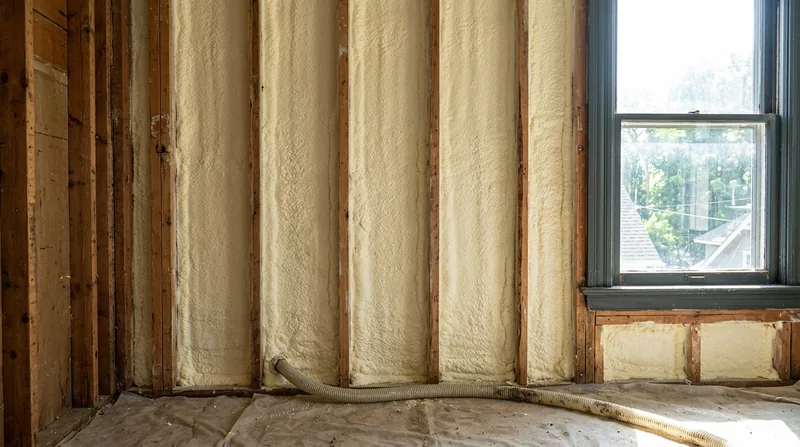




Open cell spray foam insulation in Sioux City fills the odd framing bays and rafter cavities across the city's mid-century ranches and hillside homes, cutting summer heat and winter cold swings while dampening sound from neighboring rooms. Sioux City's continental climate, windy, cold winters along the Missouri River and humid summers, pushes moisture vapor inward and outward through attics and walls with the seasons, and open cell foam's vapor permeability handles that swing better than rigid barriers alone. Homes across Morningside, the Loess Hills above downtown, and the newer subdivisions toward Sergeant Bluff all carry attics that leak warm air in winter and let hot air settle in summer, driving heating and cooling bills higher than they need to be. Open cell foam expands to seal those cavities completely, cutting air leakage and improving comfort year-round. We've been installing spray foam insulation across Woodbury, Plymouth, Sioux, Monona, Cherokee and Ida counties since 2015, and we know the failure modes that repeat in this region: a vented attic over a bonus room, a cold rim joist at the basement line, and a damp crawl space that sweats all summer without air sealing. This guide walks you through what open cell foam does, how we install it, what it costs, and how to find the right contractor for your home.
Why Open Cell Spray Foam Insulation Matters in Sioux City's Climate
Sioux City's seasonal extremes, from sub-zero winters with wind chill readings that drive outdoor temperatures to minus 20 and below, to summer humidity that climbs above 70 percent, create two distinct pressure regimes inside your attic and walls. In winter, warm indoor air wants to escape through the attic, carrying moisture that condenses on cold framing and sheathing; in summer, humid outdoor air pushes inward through leaky rim joists and vented attics, cooling and condensing inside walls and crawl spaces. Open cell foam seals those cavities and allows vapor to move through the material itself rather than pooling at interfaces, which is especially important in Siouxland's bipolar seasonal swing. Older homes with flattened, settled fiberglass insulation cannot keep up with that pressure, and newer vented attics over bonus rooms and garage additions still leak air around plates and penetrations. Open cell foam expands to fill irregular framing bays, seals around wiring and plumbing, and maintains its air-blocking properties through both seasons.
- Open cell foam expands to fill odd framing bays and irregular cavities that fiberglass batts leave gaps around.
- The material's vapor permeability allows seasonal moisture swing without trapping condensation at material interfaces.
- Air sealing around electrical boxes, plumbing penetrations, and top plates cuts infiltration that fiberglass cannot address.
- Sound dampening in interior walls and between rooms improves comfort in mid-century ranches where wall thickness is minimal.
- Lower density than closed cell foam makes it cost-effective for attics and non-structural cavities where high compressive strength is not required.
These benefits combine to reduce the heating and cooling load that drives high utility bills across Sioux City's residential stock.
Local reality: A mid-century ranch in Morningside with original fiberglass insulation and a vented attic over the main living space loses heat through the attic all winter and gains heat through the same path in summer. Sealing that attic with open cell foam and air sealing the rim joist at the basement line cuts the temperature swing between floors and reduces the run time of both furnace and air conditioning.
For more detail on how air sealing and insulation work together, see our air sealing service page.
How We Install Open Cell Spray Foam Insulation in Sioux City Homes
Open cell foam installation begins with a site inspection to identify all cavities, air leaks, and substrate conditions. We confirm that the attic or wall framing is dry before we spray, and we mark the thickness and R-value target based on the code in force at your address and your home's use. We set up mechanical ventilation during the cure period to manage off-gassing, and we establish a re-entry window of 24 to 48 hours depending on temperature and humidity. The foam is sprayed in controlled passes at the correct drum temperature and material ratio, expanding to seal every cavity and penetration. Once cured, we trim excess foam flush to the framing and verify the finished thickness and coverage.
- We inspect the attic or wall cavity for moisture, active leaks, or contamination that would require repair before foam is applied.
- We establish the R-value and thickness target based on the building code in force at your address and confirm it in the written estimate.
- We install mechanical ventilation during the cure period to manage VOC off-gassing and ensure safe re-entry.
- We spray the foam in controlled passes at the correct drum temperature and material ratio to achieve uniform expansion and density.
- We trim excess foam and inspect the finished cavity to confirm complete coverage and the specified thickness.
- We document the installation with photographs and a completion report that shows R-value, thickness, and date of installation.
This process ensures that the foam is installed correctly the first time and that you have a clear record of what was done.
Example job: A ranch home in Le Mars with a vented attic over the master bedroom and a cold rim joist at the basement line. We seal the attic cavity with open cell foam to R-38, air seal around the rim joist with closed cell foam to stop the cold draft, and install mechanical ventilation during cure. The homeowner sees an immediate reduction in the temperature difference between the master bedroom and the rest of the home, and heating bills drop by 12 to 18 percent in the first winter.
If you have existing insulation that needs to be removed before we spray, see our insulation removal service.
Open Cell Spray Foam Installation Methods
| Method | Description | Best for |
|---|---|---|
| Full attic cavity fill | Spray open cell foam to the full depth of the rafter cavity, creating a sealed and insulated assembly from the roof deck to the top plate. | Vented attics over living spaces, bonus rooms, and master bedrooms where air leakage and thermal bridging are the main loss paths. |
| Top-up over existing insulation | Spray open cell foam over settled or compressed fiberglass batts to reach the target R-value and seal air leaks around edges and penetrations. | Older attics where the existing insulation is still sound but insufficient, and where removal and replacement would be costly and disruptive. |
| Interior wall cavity fill | Drill access holes through the exterior wall sheathing or interior drywall, and inject open cell foam into the cavity to fill framing bays and seal air leaks. | Retrofitting closed walls in pre-1980 homes without demolition, and adding sound dampening between rooms in mid-century ranches. |
| Crawl space and rim joist | Spray open cell foam on the underside of the rim band and into the rim joist cavity to seal the cold draft and reduce moisture infiltration from the foundation. | Basement rim joists in Loess Hills homes and hillside lots where the rim is exposed to cold and damp, and where crawl space temperature and humidity drive heating and cooling loads. |
Open Cell Spray Foam Insulation Cost in Sioux City: What to Expect
Open cell spray foam insulation in Sioux City typically starts at $0.55 per board foot, with the final cost depending on the cavity size, the R-value target, access to the space, and the thickness of foam required. A typical attic cavity fill runs 3 to 5 inches deep and costs $1,200 to $3,500 depending on the square footage and framing layout. A rim joist seal on a full basement perimeter costs $800 to $1,600. Interior wall cavity fills cost $600 to $1,200 per wall depending on the number of bays and the presence of wiring or plumbing. The per-board-foot rate reflects the material cost, equipment, labor, ventilation setup, and the time required to cure and trim. Thicker applications for higher R-values and irregular cavities that require more passes cost more per board foot. We provide a written estimate with the R-value, thickness, and board footage specified so you know exactly what you are paying for.
Getting 2 to 3 estimates from different contractors is smart practice. Compare the R-value and thickness in each estimate, not just the price. A low bid with no R-value stated or a thickness that seems thin is a red flag. Visit our pricing page for a full breakdown of service costs and factors that affect the final bill.
Open Cell Spray Foam Insulation Near Me: What Sioux City Homeowners Should Know When Hiring a Contractor
Hiring the right spray foam contractor is critical because poor installation, wrong material ratio, inadequate ventilation during cure, immediate re-entry before the foam is cured, or foam sprayed over wet or contaminated substrate, creates problems that are expensive to fix. Verify that any contractor you are considering is fully insured and carries liability coverage that names spray foam installation. Ask for references from recent jobs in your area, and call them to confirm that the work was completed on time, that the foam smell dissipated within the stated re-entry window, and that the homeowner is satisfied. Get a written estimate that includes the R-value, thickness, board footage, and the re-entry window. If the estimate has no R-value or thickness, walk away. Ask whether the contractor will pull permits if your city requires them for attic work, and confirm what applies at your address by calling your local building department. Some HOA rules in master-planned areas govern exterior work on metal buildings, so check your architectural guidelines before booking. Call us at (712) 522-2693 or visit our contact page to schedule a free estimate and ask any questions about how we work and what to expect.
- Confirm that the contractor is fully insured and carries liability coverage for spray foam installation work.
- Request references from jobs completed in Sioux City or nearby cities within the last 12 months.
- Ask for a written estimate that specifies the R-value, thickness, board footage, and the re-entry window.
- Verify what permits apply at your address by calling your local building department or asking the contractor to confirm in the estimate.
- Check your HOA architectural guidelines if you live in a master-planned community, especially for exterior work on metal buildings or additions.
- Ask whether the contractor provides a completion report with photographs and documentation of the installation.
Taking time to hire carefully protects your home and ensures that the work is done right.
Open Cell Spray Foam Insulation in Sioux City: Pricing Guide
| Service | Price | Details |
|---|---|---|
| Attic cavity fill (full depth, open cell) | Starting at $0.55/board ft | Cost per board foot multiplied by the volume needed to reach target R-value; larger attics with clear framing cost less per board foot than small attics with complex framing |
| Rim joist and band joist sealing | Starting at $800 | Price for a typical full basement perimeter with 2 to 3 inches of closed cell or open cell foam; longer perimeters and deeper rim joists increase cost |
| Interior wall cavity fill (injection foam) | Starting at $600 | Cost per wall cavity depending on the number of bays, wall height, and presence of wiring or plumbing that requires careful navigation |
| Top-up over existing insulation | Starting at $0.55/board ft | Foam applied over settled fiberglass costs the same per board foot; total cost depends on the depth needed to reach the target R-value |
| Travel and setup | Included | No separate mileage fee or travel charge within Sioux City and surrounding service areas; included in the estimate and final invoice |
| Free written estimate | No charge | Response within 24 hours at (712) 522-2693; estimate includes R-value, thickness, board footage, and re-entry window with no obligation to book |
Indicative pricing, the exact cost depends on square footage, finish, and site access. Free personalized estimate within 24h at (712) 522-2693.


