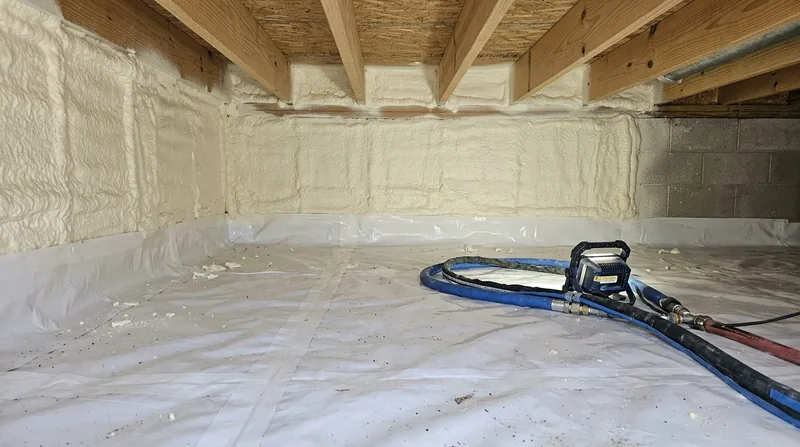




Newer homes in subdivisions around Sergeant Bluff and toward the outskirts of Sioux City often sit on crawl spaces that trap humid air and winter cold. Summer storms push moisture into these spaces, and the cold that settles there in winter makes the rim joists and band joists sweat and leak into the structure above. Crawl Space Spray Foam Insulation in Sioux City seals these spaces and stops the moisture cycle that follows the continental climate swings across Woodbury County. We spray closed-cell foam across the walls, seal the rim joist transitions, and create a conditioned, dry buffer between the earth and your living space. The result is lower heating and cooling bills, no more damp crawl space smell, and a structure that does not lose heat to the ground in January or gain humidity in July.
Why Crawl Space Insulation Matters in Sioux City's Climate
The Sioux City area sits at the edge of the continental climate zone where winter temperatures drop well below freezing and humidity swings wildly between seasons. Crawl spaces that sit uninsulated or with only fiberglass batts become cold zones in winter and damp zones in summer. The rim joist and band joist, the wood frame where the crawl space meets the house, loses heat directly to the ground in January and absorbs moisture from rising damp in July and August. Homes in subdivisions like those around Sergeant Bluff, Hinton, and Le Mars experience this cycle every year, and the cost shows up in heating and cooling bills that climb faster than they should.
- We seal the crawl space walls with closed-cell spray foam to stop air infiltration and moisture vapor from entering the living space above.
- We insulate the rim joist transition where the foundation wall meets the house frame, the single biggest heat leak in a crawl space structure.
- We create a thermal and moisture barrier that stays effective across the seasonal swings that dominate Siouxland weather patterns.
- We ensure the space remains dry by stopping the vapor drive that pushes inward from the ground in summer and outward from heated living spaces in winter.
Stopping moisture and heat loss at the crawl space is the fastest way to lower energy costs and protect the rim joist from rot.
Key info: Crawl spaces in newer additions across Woodbury, Plymouth, Sioux, and Monona counties sit on clay and silt soils that hold moisture. A single summer thunderstorm can saturate the ground around the foundation, pushing that moisture into an uninsulated crawl space for weeks. Closed-cell spray foam stops that vapor before it enters the house.
For more on how moisture and heat loss work together in your home, see our page on Rim Joist and Band Joist Spray Foam Insulation, which covers the same moisture control strategy at the critical transition point.
How We Insulate and Seal Your Crawl Space: Step by Step
Crawl space insulation is not a one-size-fit-all job. We start with a moisture assessment, determine whether the space is wet or dry, and then spray closed-cell foam to the walls and rim joist. The foam cures to a rigid finish that resists moisture and creates an air-tight seal. We control the spray pattern, thickness, and cure time to meet code and ensure the space stays dry and conditioned.
- We inspect the crawl space for standing water, active moisture, or damage that must be addressed before foam can be applied.
- We seal all rim joist connections and wall-to-foundation transitions with closed-cell foam to stop air leaks and vapor drive.
- We spray foam to the specified thickness (typically 1.5 to 2 inches) to achieve the R-value your space requires.
- We ventilate the crawl space during cure and observe the manufacturer's re-entry window before you return to normal use.
- We verify the finished installation against the specifications on your written estimate, including R-value and foam thickness.
The result is a sealed, insulated crawl space that holds temperature and stays dry year-round.
Example: A 1,200-square-foot addition in Sergeant Bluff sits on a crawl space with 8-foot walls and a damp rim joist. We spray 1.5 inches of closed-cell foam to all walls and seal the rim joist transition. The job takes one day, the space cures overnight, and by the next morning the homeowner can move back into the addition without odor or off-gassing. The crawl space stays at 50 to 55 degrees year-round instead of swinging between 35 degrees in January and 75 degrees with 90 percent humidity in July.
For details on the air sealing work that complements crawl space foam, visit our Air Sealing page.
Crawl Space Spray Foam Methods: Closed-Cell vs. Open-Cell
| Approach | Description | Best for Crawl Spaces |
|---|---|---|
| Closed-Cell Spray Foam | High-density foam (1.5 to 2 lbs/cubic foot) with a rigid finish and high R-value per inch (R-6 to R-7). Resists moisture vapor and air infiltration. | Standard choice for crawl spaces. Stops moisture, holds R-value, and creates an air-tight seal that lasts decades. |
| Open-Cell Spray Foam | Lower-density foam (0.5 lbs/cubic foot) with an open structure. Lower R-value per inch (R-3.5 to R-4) but cheaper per board foot. | Not recommended for crawl spaces. Open structure allows moisture to pass through, which defeats the purpose of moisture control. |
| Fiberglass Batts or Blown-In Insulation | Traditional insulation that does not create an air seal and absorbs moisture when exposed to humidity. | Not effective in crawl spaces. Moisture passes through fiberglass, batts sag and compress, and air leaks continue around the edges. |
| Rim Joist Foam + Wall Foam Combo | Closed-cell foam applied first to the rim joist transition, then extended down the crawl space walls to create a continuous thermal and moisture barrier. | Most effective approach. Seals the heat-loss zone first, then extends protection to the full crawl space, ensuring no gaps or cold spots. |
Crawl Space Spray Foam Insulation Cost in Sioux City: What to Expect
The cost of crawl space insulation depends on the size of the space, wall height, and whether the rim joist needs separate attention. Most crawl spaces in Sioux City additions range from 800 to 1,500 square feet of wall surface. Pricing starts at around $2,500 for a smaller space and grows with wall area and access difficulty. We provide a written estimate that specifies the R-value, foam thickness in inches, and total board feet so you know exactly what you are paying for.
- A typical 1,000-square-foot crawl space with 8-foot walls and a damp rim joist runs from $3,000 to $4,500 depending on access and the extent of air sealing needed.
- Larger spaces or those with multiple rim joist sections, piers, or tight access points cost more because they require more material and careful spray technique.
- Spaces with active moisture or standing water require remediation before foam can be applied, which is a separate conversation with a drainage specialist.
- Travel is included in our service area across Sioux City, Sergeant Bluff, Hinton, Le Mars, Hawarden, and surrounding towns.
The best way to understand your cost is to get a free estimate. We measure your space on site, assess moisture conditions, and give you a firm price with R-value and thickness spelled out. See our pricing page for more detail on what moves the cost up or down, and call us at (712) 522-2693 for a no-obligation conversation about your crawl space.
Crawl Space Spray Foam Insulation Near Me: What to Look for When Hiring a Contractor in Sioux City
Choosing a spray foam contractor is a decision that affects your home for decades. A poorly installed crawl space foam job, wrong thickness, bad ratio, or rushed cure, will fail to seal moisture or hold R-value. The right contractor will give you a written estimate with R-value and thickness, use proper equipment and technique, and stand behind the work. Here is what to verify before you hire anyone, including us.
- Ask for a written estimate that lists the R-value per inch, total foam thickness in inches, and the total board feet to be sprayed.
- Verify that the contractor uses mechanical ventilation during cure and states a clear re-entry window of 24 to 48 hours before you occupy the space.
- Request references from recent jobs in Sioux City, Sergeant Bluff, or nearby towns and call them to ask about the installation quality and whether any issues arose after cure.
- Confirm that the contractor carries general liability and workers compensation insurance and ask for a certificate of insurance.
- Check whether your local building department requires a permit for crawl space insulation at your address and whether the contractor will help you navigate that process.
- Ask about the workmanship warranty and what is covered if the foam fails to cure properly or if seams separate.
A local contractor with a track record in Sioux City and Woodbury County is your strongest choice. We are fully insured, provide written estimates with R-value and thickness, and have been in business since 2015. If you are ready to move forward, call us at (712) 522-2693 or visit our contact page to request a free estimate.
Crawl Space Spray Foam Insulation in Sioux City: Pricing Guide
| Service | Price | Details |
|---|---|---|
| Small crawl space (800-1,000 sq ft) | Starting at $2,500 | Wall insulation and rim joist sealing on compact addition spaces with standard 8-foot walls and good access |
| Standard crawl space (1,000-1,500 sq ft) | Starting at $3,500 | Typical addition in Sergeant Bluff or Sioux City subdivision with 8-foot walls, multiple rim sections, and moderate access |
| Large or complex crawl space (1,500+ sq ft) | On estimate | Extensive wall area, high ceilings, tight access, piers, or multiple rim joist transitions require site inspection for accurate pricing |
| Rim joist only (no full crawl space foam) | Starting at $1,200 | Focused air sealing and insulation at the rim joist transition when full crawl space closure is not needed or desired |
| Travel | Included | No mileage fee or travel surcharge for Sioux City, Sergeant Bluff, Hinton, Le Mars, Hawarden, and surrounding service areas |
| Free estimate | No obligation | Written estimate with R-value, thickness, and total cost delivered within 24 hours by phone or email at (712) 522-2693 |
Indicative pricing, the exact cost depends on square footage, finish, and site access. Free personalized estimate within 24h at (712) 522-2693.


